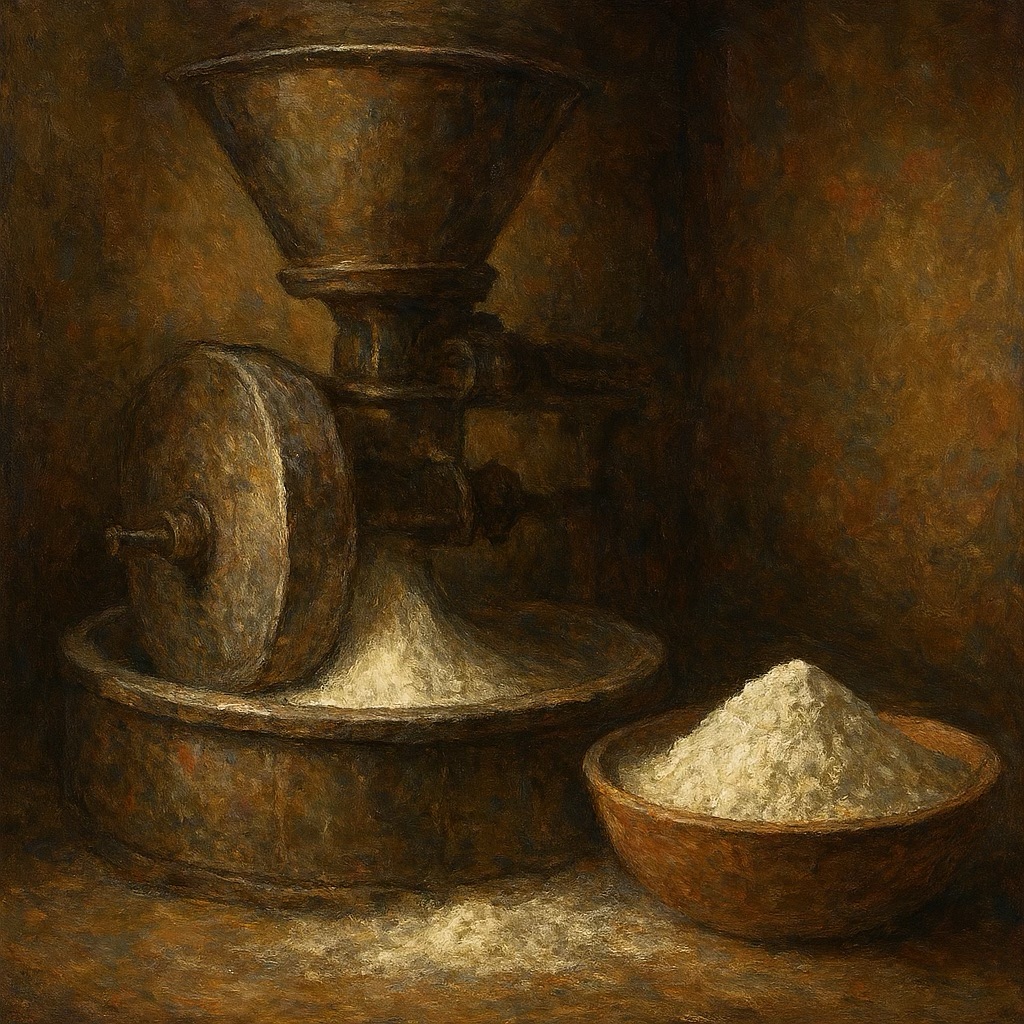
There is a quiet shift happening in the way we think about flour.
For years, flour has been treated as a pantry staple: neutral, interchangeable, and largely overlooked. But once you begin working with freshly milled flour, that perception changes. You start to see flour not as a static ingredient, but as something living, responsive, and deeply tied to how we nourish ourselves.
So is freshly milled flour actually healthier than store-bought flour? The answer depends on how you define healthy—but nutritionally, structurally, and experientially, there are meaningful differences.
What happens to store-bought flour
Most commercial flour is refined and processed to extend shelf life and create consistency in baking. During this process, the bran and germ, the most nutrient-dense parts of the grain, are often removed. What remains is primarily the starchy endosperm.
Even when flour is labeled “whole wheat,” it is typically milled, stripped of its natural oils, and then stored for extended periods before it reaches your kitchen.
This matters because once a grain is milled, it begins to oxidize. Over time, flavor fades and certain nutrients degrade. The result is a stable, predictable ingredient—but not necessarily a vibrant one.
What makes freshly milled flour different
Freshly milled flour is exactly what it sounds like: whole grains ground moments before baking.
Nothing is removed. Nothing is sitting on a shelf for weeks or months. The bran, germ, and endosperm all remain intact, in their natural proportions.
This means:
- The full nutrient profile is preserved at the moment of use
- Natural oils and flavors are still present
- The flour behaves differently in fermentation and hydration
- The taste is noticeably more complex and “alive”
There is also a subtle but important difference in how it feels to work with. Fresh flour absorbs water differently, ferments more actively, and produces dough that often feels more responsive and less uniform.
Nutritional perspective: where it actually matters
From a nutritional standpoint, freshly milled flour offers a more complete version of the grain. It contains the full spectrum of fiber, vitamins, minerals, and natural oils that are often diminished or altered in refined flour systems.
Some commonly noted differences include:
- Higher levels of naturally occurring nutrients (such as B vitamins and antioxidants)
- Increased fiber content from the intact bran
- Presence of natural oils from the germ, which are typically removed or reduced in shelf-stable flour
It’s important to note that flour, fresh or not, is still a carbohydrate-dense food. The context of your overall diet always matters more than a single ingredient. But freshness does change the integrity of what you are working with.
The role of digestion and fermentation
One of the most interesting differences shows up in fermentation, particularly in sourdough baking.
Freshly milled flour often ferments more actively due to its intact structure and enzyme activity. This can influence how the dough rises, how acids develop, and how the final bread is digested.
Many people find that breads made with freshly milled flour feel more satisfying and easier to tolerate. While individual responses vary, this is one of the most commonly reported shifts when people move away from store-bought flour.
So, is it healthier?
If “healthier” means more nutrient-dense, less processed, and closer to its original form, then yes, freshly milled flour has a clear advantage.
But the deeper distinction is not just nutritional. It is sensory and relational.
Freshly milled flour changes how you bake. It slows you down. It connects you more directly to the grain itself. It turns something industrial and standardized into something tactile and intentional.
And that shift toward awareness, toward craft, toward simplicity is often where real change in health begins.
A final thought
Health is rarely found in extremes or labels. It is shaped in the small, repeated choices we make in our kitchens and daily rituals.
Freshly milled flour is not a trend or a replacement for everything that came before it. It is simply a return to freshness, to texture, and to the quiet complexity of real food.
And sometimes, that is enough to change the way we eat entirely.
 Howe to Health
Leave a comment